Wow, the article started out with references to the Mirror Stage of the Oedipal Complex… after that, I kind of expected the author to focus on childhood trauma and I certainly wasn't disappointed. While only a brief part of Ken Lum's history, it would make sense that such events would go on to inform his interest in identity and culture that's so consistently present in his work. The work he does with signs is likely my favorite, though I do enjoy his work with mirrors. The 'personal logos' (as I believe he called them in his talk) have a quirky humor to them that make them very approachable. Though their meaning has shifted over the decades, viewers can still have an idea of political climates of the past to help inform their impressions of the work. There's an interesting conflict that happens in my mind when he 'casts' the East Asian man as "Steve"; while he does confront the discrimination of the time, he also strips away the person's identity to have them act the role they've been given. I think this is effective in creating conflicting feelings of amusement and discomfort; it certainly bothered me!
Aesthetically, his mirrors and inserted photographs are beautiful in a nostalgic kind of way, but I'm not certain if I would necessarily end up considering the same things if they were presented without his previous work with signage in the same show.
Monday, March 16, 2015

Abstracting Photography- Walead Beshty
I love Walead Beshty's work- I really do. His prose, perhaps, could do with a little simplification- it was an incredibly dense article in theory, history, and vocabulary.
In Beshty's essay, he constructs a 22-page journey that meanders along photographic history and theory, making pit stops at many crucial moments along the way. From Barthes to Baker, he painstakingly tracks the rises and falls of photography as an artistic medium, moving towards the contemporary fear of the "death" of photography.
"…the Barthesian theorization of the "this has been" contained in the photographic image, has become the "this has been" of "Photography" itself." (293)
What Barthes refers to with "this has been" is the idea that there is both an objective and subjective record of something that has concretely happened; Beshty takes this a step further in arguing that the state of photography is spiraling into disintegration as the referent and context become further and further apart.
By tracking the numerous idiosyncrasies of the medium, he is able to pinpoint multiple locations that photography falls apart, yet I would personally argue that these places are ripe to be mined of interesting work- isn't that what the Conceptual art movement set out to do with the murky referred/referent relationship that photography has? But he presses on, pointing out the conflicting nature of photography in its dimensionality (it's both an object and a compressed representation of another reality), its inherent documentative power (photojournalism, snap chat, etc), its utilization in shaping culture/politics (photojournalism, 'leaked' pictures, hacked data, etc), and its Cartesian functionality for categorizing things (Anna Atkins comes to mind).
Through all these sources, it becomes apparent that he is interested in the subjective/objective duality of the photograph, and the 'dead' quality that it takes on in relation to the moment it endeavors to represent. Though the majority of people understand that photos are mere facsimiles, we are often swayed by 'visual evidence' that they seem to provide, even though the awareness of manipulation and tampering is ubiquitous.
He basically comes to rest upon the suggestion that, by using new 'methodologies' to create photographs, artists can expand the meaning of photography while simultaneously questioning and critiquing the historical foundations of the medium. By abstracting photography, the viewer is helped to confront the inherent subjectivity of photographs; if the referent is absent, then what becomes of the photographic reference? His personal preference for exploring the 'in-between' spaces seems to parallel this murkiness that photographs often enter with the divergence of content/context.
CAVEAT: Trying to do a reasonable summary that properly articulates all of his theory is well outside of my capabilities, as I'm not entirely sure what he's implying all the time; the essay is very complex and he speaks metaphorically quite often, which complicates things.
Creating Artist's Books
…is harder than it looks!
As for my summary:
As for my summary:
Rebecca Senf’s blog post is a rather detailed walkthrough of
the myriad considerations an artist is face with when self-publishing a book;
in addition to mentioning some pitfalls, she provides photos of examples that
she reviewed during the jury selection of books to be presented in the 2014
exhibition of Self-Published Photo Books. The major points she brought up were:
typeface, editing (paring down, specifically), form (does the book match
content/intent?), text placement, trim size, pitfalls of templates, and why
getting help matters.
The various books she selected were extremely helpful in
seeing exactly what ‘works’ and why, though I would have liked to see examples
of what doesn’t work as well- I can understand from her perspective as a juror
that it would be inappropriate to show books submitted as such examples. That
said, though, the incredible variety shown still astounds me, even after the
guided tour of the artist books at the library.
I was very interested in her short section on typeface-
having struggled with fonts that don’t ‘work’ on projects, I zeroed in on her
suggestions. Taking photos of books that are inspirational has been something
I’ve done for a few years now, so the idea of snapping fonts that might be good
references make a lot of sense. I wish she’d have divulged her favorite fonts,
though!
On a related note, I often see fonts I like on websites, so
I did a lot of searching and found several great plugins that allow you to see
the font information on type you hover over with the cursor.
WhatFont (Chrome)
Font Finder (Firefox)
Who Cares About Books?
I do!
As for my response:
In the essay, ‘Who Cares About Books?’, author Darius Himes
sets out to pinpoint why photobooks are still important in contemporary
(digital) culture. For the first few pages, he explains our sentimental,
historical, and tactile bonds with books, and why the materiality of a book
seems to be of such importance in an age of e-readers. He also traces the
impact of books on history, and how they shaped the development of civilization
(suffice to say they were integral). He
writes about several “books about books”, the recent publications that select
key tomes of importance and investigate the history of the photo book.
In the latter half of the essay he talks about two specific
photo books (Bye Bye Photography and A Shimmer of Possibility), comparing and
contrasting their qualities and the impact they have on the reader. Following
these, he finally explains why we are in the “Golden Age” of the photo book.
His theorizes that due to the accessibility of cameras, ease of digital workflow,
and presence of many ‘print-on-demand’ companies emerging online, the amount of
photo books available on the market will skyrocket, allowing readers greater
diversity and artists more options. The ability of the artist to bypass
editors, designers, and booksellers allows publication with far more ease, but
I must admit, I’m slightly wary. While I think the ability to publish through
an online printer such as Blurb is phenomenal, it’s worth noting that the book
options of such businesses may lead to a certain homogeneity in photo books-
photographers will have to work hard to make sure that their content can work
strongly in their limited format options!
Thursday, February 12, 2015


Tuesday, February 3, 2015
Custom Camera Profiles Exercise
 |
| Uncorrected indoor image |
 |
| Profile-corrected and edited |
 |
| Uncorrected outdoor image |
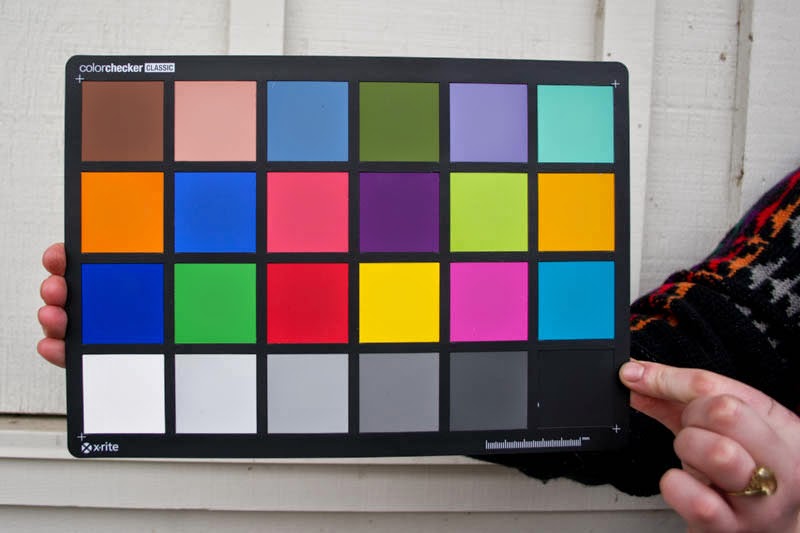 |
| Profile-corrected and edited |
Tuesday, January 13, 2015
Old Work/New Inspirations Assignment
In my work, I frequently explore the physical nature of the
materials and phenomena we depended (and still depend) upon in photography. I
explore via experimentation, applying my accumulated knowledge of chemistry and
physics to procedures that I think can produce interesting effects. The project
I am the most involved with right now depends upon the deliberate misuse of
canned air. By spraying it upside-down, I freeze a variety of light sensitive
media and create exposures as the ice recedes, creating a record of both the
ice and the mechanical changes that may have been precipitated by the massive
temperature fluctuation. I’ve used film and paper extensively, and am currently
branching into manipulating wet collodion plates with this technique (which I
affectionately refer to as ‘cryogramming’) on both tin and glass. I am pursuing
this most rigorously on glass, due to the capability for enlargement; I don’t
know yet what a print using a cryographic negative will look like, though I can
speculate based on test images I’ve taken of spraying the frost onto a variety
of materials to study the patterns. I am trying to better understand the
fundamental mechanics of the tools I utilize with so that I can more deeply
engage with my darkroom and alternative process work.
I present Alison Rossiter as an artist that I admire, as her
work with expired film is similar in it’s exploration of the physical medium.
While she simply allows the decay of these materials to speak for themselves
and I deliberately abuse the tools I work with, I believe there are
congruencies; moreover, I find her work beautiful in it’s simplicity and
concept. As the silver in the paper or film she used aged (some being almost a
hundred years old!) it lost sensitivity to light, was exposed through leaks, or
was damaged via a myriad of other accidents. She also utilizes dipping,
painting, and experimentation in the development process which create
incredible artifacts and what she describes as “finding” images.
 |
| Katherine Carlson, 2014. Cryographic Tintype |
 |
| Alison Rossiter, 2010. Silver Gelatin Print on expired paper |
Subscribe to:
Posts (Atom)